
Muscogee Previous-Resident Source Eras
No single roll names everyone who lived at a Columbus property. The best timeline combines title evidence with records made close to the period being studied. Muscogee property cards offer a current start. Deeds preserve ownership, while directories, census schedules, and local indexes can name past residents who never held title.
| Source | Verified years | Where held | What it shows |
|---|---|---|---|
| Assessment roll | Current roll; ownership January 1, 2026 | CCG Assessors | Owner, parcel, mailing and situs |
| Deeds | County creation onward; web cutoff unstated | Clerk / GSCCCA | Title parties and legal descriptions |
| City directories | Collection 1850-1950 | DLG / Columbus library | Occupants and occupations |
| Census | Public through 1950 | NARA / library | Households and tenure |
| Sanborn maps | 1889, 1895, 1907, 1929/1958 | LOC / library | Building and address context |
Start with the newest dependable source, then work backward. A directory supports occupancy, not ownership. A deed proves a title transfer, not that every grantee lived there. Agreement between the two is stronger than either record alone.
Muscogee Previous-Resident Address Records
The CCG Public Access address search is the practical first stop. Enter the street number and street core. If a direction or suffix fails, shorten the text or use Map Search. Save the parcel ID, physical or situs address, owner name, mailing address, legal description, sale history, and roll date.
Situs means the parcel's physical location. The mailing address is where tax notices go. Different addresses may suggest that an owner receives mail elsewhere, but they do not prove vacancy. A homestead notation supports owner occupancy. It still cannot name every past resident or current household member.
Insider tip. A deed filed after the assessor's ownership date may be newer than the parcel card, so compare dates before naming an owner.
Trace Muscogee Previous-Resident Deeds
The Muscogee Clerk Real Estate Division records deeds, liens, plats, and real-estate UCC filings. A backward title search follows each seller into the deed by which that seller once bought the same lot. Sales-history rows are leads; the recorded instrument and matching legal description carry the proof.
- Copy the current assessed owner, parcel ID, and legal description.
- Find that owner's acquisition deed as grantee, the party receiving title.
- Search its grantor as an earlier grantee and match the same land.
- Repeat through each book/page or instrument link.
- When the web trail ends, request the older index and deed books.
- Grantor and grantee
- The grantor gives an interest; the grantee receives it.
- Chain of title
- The linked series of recorded transfers for one parcel.
- Legal description
- Land wording that often survives a street-number change.
The mailed-copy form accepts party names, property address, filing date, book type, book number, and page. It states processing may take ten business days. The clerk counter and Records/Customer Service at 706-653-4358 option 1 are other documented channels.
Muscogee Previous-Resident Index Limits
The clerk does not publish an exact start year for its online deed index. Never fill that gap with a guess. Older books remain with the office. Ask for the grantor/grantee index, deed book, or plat from the relevant period. A known citation makes a counter or mail request much more precise.
FANS sends notice when a filing is tied to a name or property. It does not prove ownership, validate a filing, or replace the actual instrument. Previous residents research still needs the document and matching land description. Recording fees are also distinct from copy and certification charges.
Restore Muscogee Past Residents
Owners form the skeleton of an address history. Occupants supply the household. The DLG Columbus directory collection spans 1850-1950 in its metadata, with selected volumes searchable by OCR and PDF. The fuller shelf belongs to Columbus Public Library. The Muscogee County city directories page covers the collection in depth.
- Search an address in the nearest directory and inspect the page image.
- Record names, occupations, employer, spouse or widow notes, and residence terms.
- Repeat before and after a suspected move.
- Compare the nearest public census schedule through 1950.
- Use deeds, newspapers, and probate files to test the result.
The 1884 volume has separate White and Colored alphabets. Search both. Its abbreviations distinguish residence from boarding, while widow notes can link spouses. These facts help identify previous residents, but none establishes land ownership.
Map Muscogee Previous-Resident Addresses
Street numbers are less stable than parcels. The Library of Congress Columbus and Bibb City maps include a 1929 set republished in 1958. Earlier 1889, 1895, and 1907 sheets are also verified. Use each sheet index, then compare corners, lot shape, building outline, and nearby landmarks with a plat or directory entry.
A Sanborn map does not name all past residents. It answers whether the building stood on that lot under the address then used. Annexation and the 1971 Columbus-Muscogee consolidation also explain why catalogs shift among Columbus, Muscogee County, and CCG.
A Muscogee Resident-History Model
HABS researchers reconstructed 1636 Fourth Avenue with six deed books, directories from 1898 through 1937, and Sanborn sheets from 1907 and 1929. Deeds established transfers. Directories supplied occupants and occupations. Maps kept the same structure in view.
The work placed the house in North Commons, a predominantly African-American district whose social history is far clearer in directories than in title records alone. The same layered method suits older places in Uptown, Downtown, Wynnton, St. Elmo, and Bibb City.
Close Muscogee Previous-Resident Trails
A person may vanish because of death, a move, a surname change, or simple omission. The library's Genealogy and Local History indexes bridge those gaps with a marriage index for 1835-1929, early death and birth material, plus newspaper death and obituary indexes. Probate files may identify an administrator or heirs. Survivor addresses are dated leads, not proof of a current home.
Certified vital copies follow identity and eligibility rules. The Georgia DPH request page documents online, mail, and in-person routes.
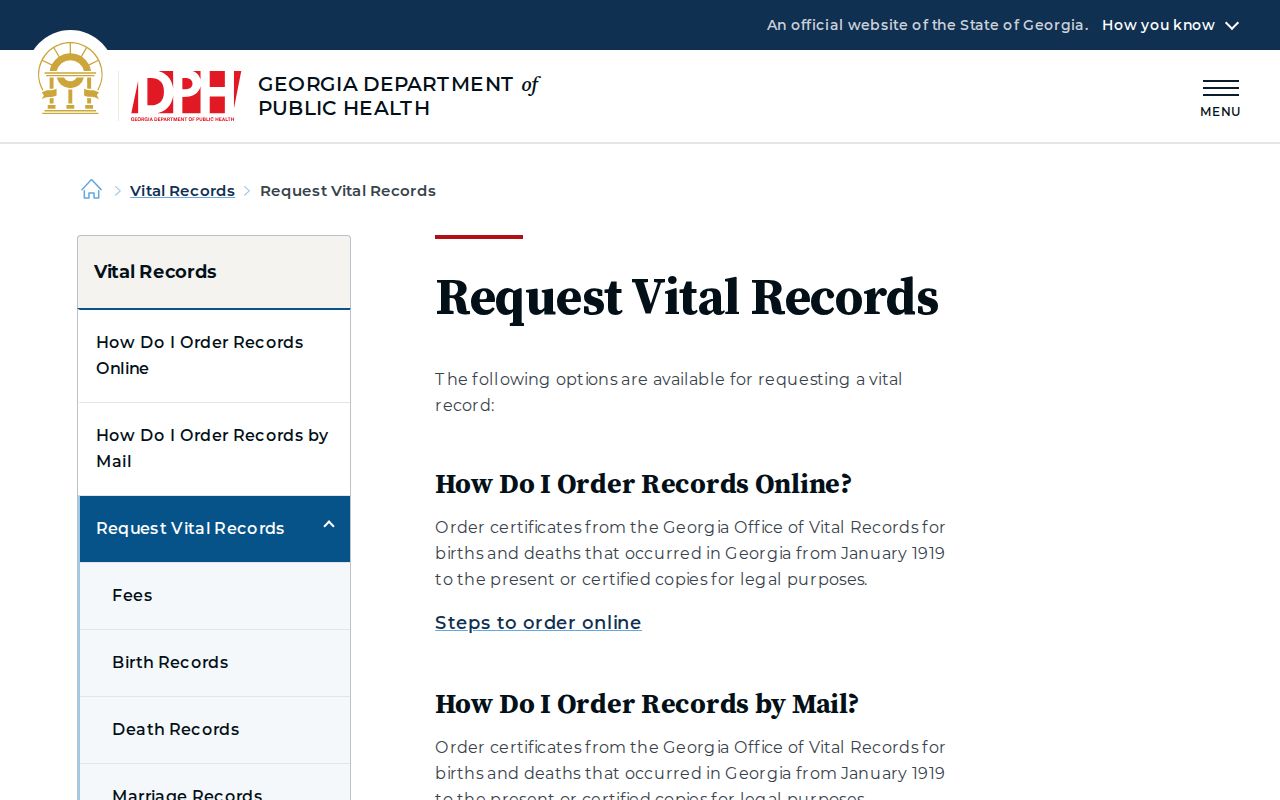
The captured page helps distinguish a searchable clue from a certified record whose release is restricted.
Verify Muscogee Previous Residents
Before adding a name to an address timeline, write a short evidence statement. State exactly what the record proves: an assessed owner on a dated roll, a grantee in a recorded deed, or an occupant printed in a directory. Then record what it does not prove. This habit prevents a former owner, boarder, relative, or permit applicant from being mislabeled as the sole resident.
Names also need care. Initials were common in early Columbus volumes. A widow notation may use the deceased spouse's given name, and OCR can fuse two columns into one false entry. Check the page image, nearby alphabetical sequence, abbreviation key, and errata pages. When two independent sources agree on name, place, and date, the conclusion about past residents is much firmer.
Research Muscogee Previous Residents Lawfully
Previous residents research serves house history, genealogy, estate work, and family reconnection. It remains incomplete. Renters may never appear in deeds, protected records stay closed, and recent census names are not public. Keep a date and source beside every conclusion. Preserve old spelling and each recorded role so another researcher can test the same evidence independently.
Georgia vital birth and death copies are confidential under state rules. Public marriage and divorce indexes have different treatment. Ask only for records the custodian may release, and avoid publishing sensitive details about living people.
Lawful use. Use Muscogee address records for legitimate personal research, never to stalk, threaten, harass, or harm anyone.