
Muscogee County Directory Collections
Columbus Public Library holds the core historical city directory collection, and the Digital Library of Georgia provides free OCR, page images, and downloadable formats for many volumes. Collection metadata spans 1850 through 1950, but that range does not mean one complete book for every year. The verified issues below give reliable starting points while the broader on-site shelf can fill gaps.
| Collection | Years documented | Keeper or publisher | Access route |
|---|---|---|---|
| Columbus city directories | Collection span 1850-1950; verified 1884, 1888, 1891-92, 1898-99, 1902, 1916, 1921, 1937, 1950, 1951 | Interstate/H.H. Dickson, Sholes, William H. Walsh, R.L. Polk; Columbus Public Library | Free DLG OCR and scans; wider library shelf |
| Muscogee marriage index | 1835-1929 | CVL Genealogy | Library web or local document |
| Birth and death indexes | Deaths 1800-1899; births August 1890-December 1900 and 1901-1918 | CVL and Muscogee Genealogical Society work | Library local-history resources |
| Newspaper indexes | Enquirer-Sun deaths 1900-1918; Ledger-Enquirer obituaries 2006-2011 | CVL Genealogy | Indexes plus newspaper microfilm |
| Sanborn maps | 1889, 1895, 1907, 1929, and a 1958 republication | Library of Congress and library holdings | Free scans and map collections |
| Federal census | Public schedules through 1950 | NARA and library databases | Free archives routes and library subscriptions |
The city directory coverage table separates a book series from the companion indexes beside it. A directory can place a name at an address. A marriage, death, birth, newspaper, or census record can then test the relationship and date.
Digitized Columbus City Directory Years
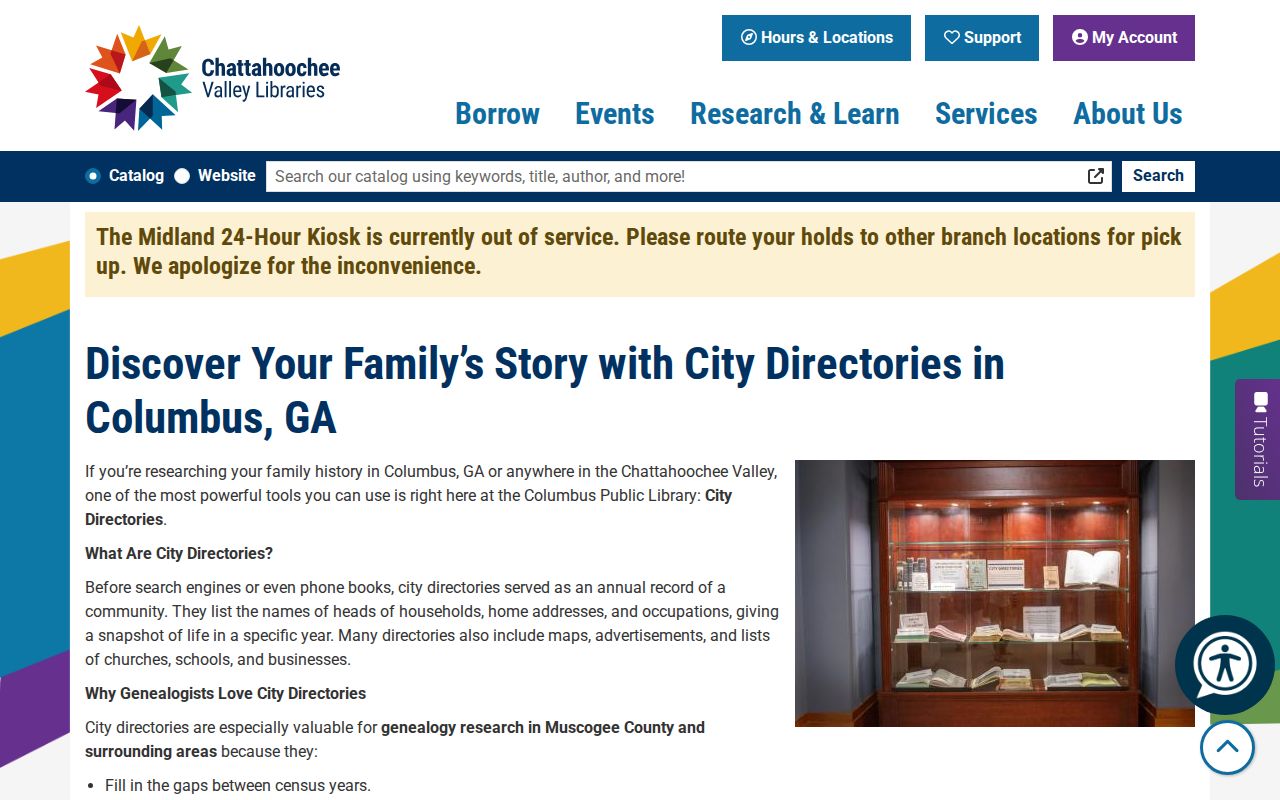
The Chattahoochee Valley Libraries city directory guide explains how the Columbus shelf supports family research and points readers toward digitized volumes. It is a current entry point to a collection that is still used and taught, not merely stored.
The Digital Library of Georgia collection supplies the remote path. Search OCR for variants, but open the image when punctuation, columns, or a surname looks wrong. The 1884 Interstate directory alone has 332 pages. Later verified publishers include Sholes, William H. Walsh, and R.L. Polk, which makes publisher and year useful citation details.
CVL renewed public outreach around these books in September 2025 and highlighted genealogy classes. That update supports a practical fallback: if the online text fails, ask library staff about the on-site issue or a neighboring year.
Read a Muscogee Directory Entry
An old entry compresses a life into abbreviations. Write down the printed form rather than expanding a word from memory. A person may be listed with initials, an occupation, employer, street reference, boarding relation, or deceased spouse. Nearby alphabetic entries and the volume key often resolve what OCR cannot.
| Name form | Surname, given name or initials, title, and sometimes a household tie |
|---|---|
| Work | Occupation such as clerk or laborer, sometimes followed by the employer |
| Address | House number and street, cross streets, or side-of-street wording |
| Household clue | res for resides, bds for boards, or residence with a named person |
| Widow clue | wid followed by the deceased spouse's name convention |
| Correction clue | Front-matter errata, changes, and removals that can replace the main entry |
- Criss-cross directory
- A later street-order section used to find names from an address.
- Householder index
- An address-oriented list of household heads or named occupants, depending on the volume.
- Abbreviation key
- The publisher's own list of shortened terms, directions, occupations, and marks.
In the 1884 key, half numbers mean upstairs. Direction marks such as ws, ns, es, and ss identify a side of the street. Neither boarding nor residence establishes legal ownership.
Search Both 1884 Directory Alphabets
The 1884 Columbus volume divides residents into “White Department” and “Colored Department.” That historical language reflects segregation, but it also changes the mechanics of a name search. A surname checked in only the first alphabet can systematically miss Black residents. Search both page ranges, spelling variants, and the scanned alphabetic sequence.
OCR errors add another barrier. Old type, damaged print, tight columns, and punctuation can fuse two entries or drop letters. Verify the page image and note the department in the citation. Do not modernize an initial, occupation, or family tie unless another source supports the change.
Search tip. Pair the surname with an employer, occupation, street, or spouse because one OCR query may not reach both segregated alphabets.
The same book carries civic, church, school, company, and classified lists. Those sections can help distinguish people who share a name, but an organizational role is not proof of residence unless the entry supplies an address.
Muscogee County Genealogy Desk
The Columbus Public Library is the major non-courthouse center for local people records. Its Genealogy and Local History Department is on the second floor at 3000 Macon Road. Staff can be reached at 706-243-2681 or CVL-Genealogy@cvlga.org. A focused request should give the person's name, spelling variants, approximate year, school or employer when known, and the exact directory or index sought.
The library genealogy and local history page describes city directories, census, newspapers, maps, military and court material, biographies, periodicals, vertical files, and subscription genealogy databases.
Its named local indexes are especially strong bridges from a city directory entry. They cover Muscogee marriages from 1835 to 1929, an 1800-1899 death register, Columbus births from 1890 to 1918 in two runs, early twentieth-century newspaper deaths, and a 2006-2011 obituary index.
Microfilm Beyond Muscogee Directories
A failed web search is not the end of the collection. Library microfilm can supply newspapers and other runs that are not easy to search online. It also preserves page layout, adjacent notices, and spelling that a text index strips away. Record the newspaper title, date, page, column, and reel when a notice confirms a directory clue.
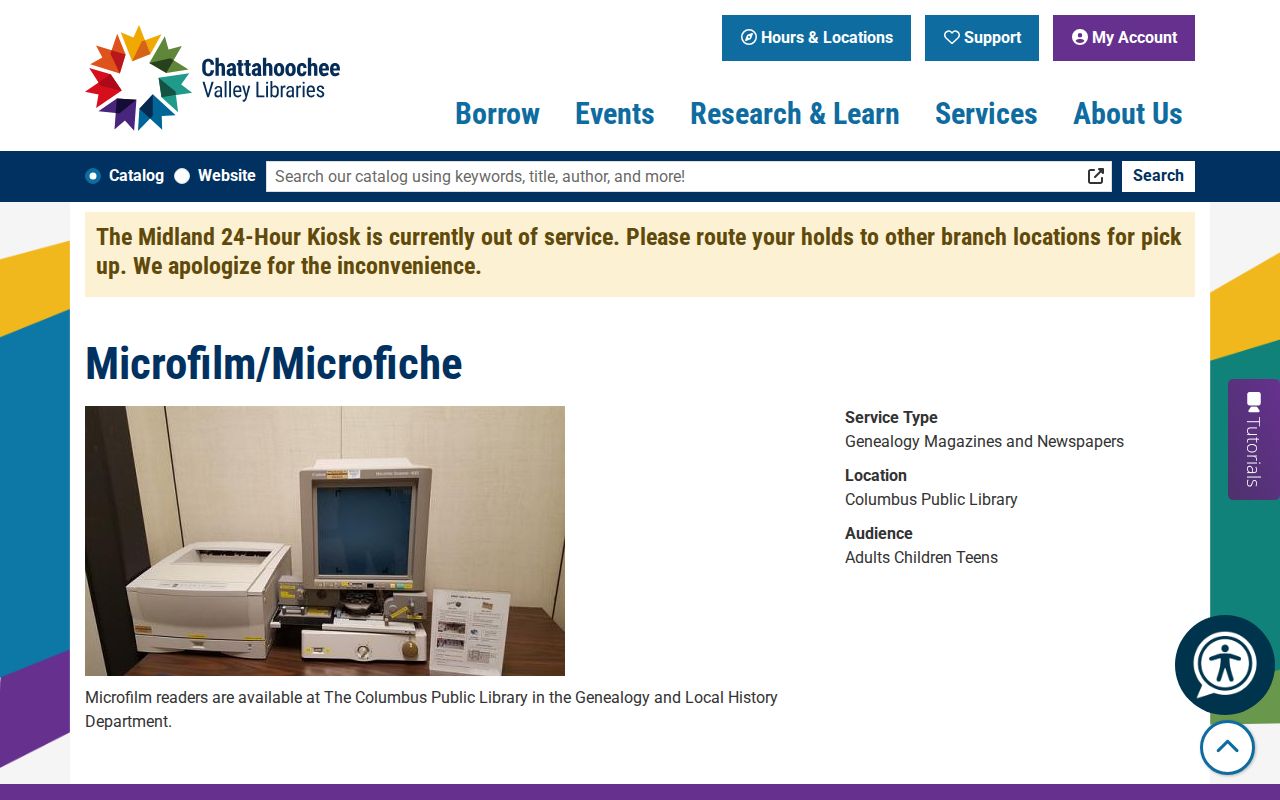
The library's microfilm and microfiche service page confirms readers and scanners in the Genealogy Department.
Newspaper death notices, legal notices, marriage reports, and civic lists can explain a disappearance or move that the city directories alone cannot. Search the library's exact indexes first, then use microfilm for the article.
Trace Muscogee Families by Year
City directories are strongest when treated as repeated snapshots. One entry may contain a deadline error. A sequence can show when a person appears, moves, changes work, boards with family, or gains a widow notation. Census schedules provide fuller household detail at longer intervals, while deeds separate owners from occupants.
- Choose a directory close to a known census, marriage, birth, or death date. Search the surname and spelling variants in every relevant alphabet.
- Transcribe the entry exactly, including initials, occupation, employer, street wording, boarding or widow notation, and the publisher's year.
- Repeat the search in the prior and next available volumes. Note changes without assuming that one missing year means departure or death.
- Pair the address with a public census schedule through 1950, then compare household members, occupation, and tenure.
- Check the matching Sanborn sheet, parcel or deed only when the question involves the building or ownership.
- Close a likely death or family transition through the CVL index, newspaper image, cemetery evidence, probate file, or eligible vital record.
This workflow keeps a city directory clue in its proper place. If the goal shifts to present parcel ownership, the Muscogee County street directory explains the modern address-keyed chain without repeating the historical shelf.
Map Muscogee Directory Addresses
Sanborn fire-insurance maps connect an old address to a building footprint, use, and street layout. Verified Columbus map years include 1889, 1895, 1907, and 1929, plus a 1929 volume republished in 1958 with 73 sheets and Bibb City. Use the sheet index and directory abbreviation key together because old numbers and cross-street wording may not match a modern parcel search.
North Commons research shows why layers matter. HABS investigators used directories from 1898 through 1937 with 1907 and 1929 Sanborn sheets and deeds to document a predominantly African-American neighborhood. A surviving house at 1636 Fourth Avenue was tied to multiple directory years and deed books, not identified from one modern owner card.
Bibb City brings a different issue. Mill-company residences can separate the employer, occupant, and legal owner trails. Directory work and occupation, Sanborn building use, industrial archives, and deeds answer distinct questions and should not be collapsed into one household statement.
Columbus Directories Cross the River
The 1950-51 Polk title includes Columbus and Muscogee County with Phenix City, Russell County, and South Girard in Alabama. Someone can move across the Chattahoochee and remain within the same printed market. That cross-river coverage is useful, but it can also send a researcher to the wrong courthouse or property system.
Check the locality printed beside the address, then use the right state's records. A Phenix City entry belongs to Alabama records geography even when it appears in a Columbus city directory. The same care applies to Fort Benning material, which may connect a person to federal military sources without creating a public local roster.
Occupation and employer can help distinguish same-named residents in a city shaped by textiles, mills, river trade, iron works, retail, and military activity. Company newsletters, yearbooks, oral histories, and archival collections may continue a trail, subject to donor and privacy limits.
Extend Muscogee Directory Research
Columbus State University Archives and Special Collections adds yearbooks, photographs, university history, regional manuscripts, and organization records. Historic Columbus, preservation files, National Register material, and HABS records connect structures with owners, architects, workers, and neighborhoods. Cemetery material for Linwood, Porterdale, East Porterdale, and Riverdale can add dates and kinship clues.
The Georgia Archives research services provide a catalog, Virtual Vault, and broader state-record support when a local directory clue points beyond Muscogee County.
Use each companion source for what it preserves. A yearbook can confirm school context, an obituary can name survivors, and a cemetery record can suggest family links. Verify each fact in the original record and treat details about living people with care.
Historical limits. A missing city directory entry may mean omission, a skipped year, a move, or a protected or institutional setting, not proof of absence.